

ADCs (Peak Sensing)
Analog
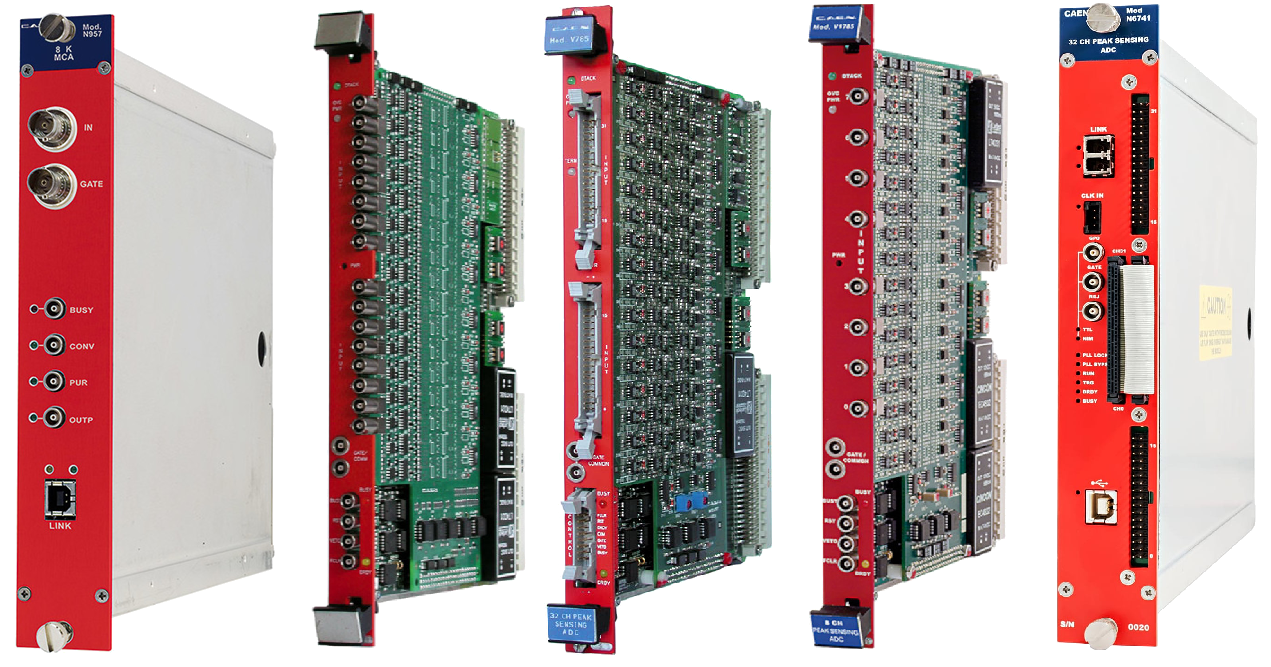
Overview
The ADCs (Peak Sensing) family provides high-channel-density digitization of shaped detector pulses, enabling precise conversion of peak amplitude into digital energy information for spectroscopy and radiation measurements. These modules combine fast peak-detection architectures with low dead time, multi-event buffering, and digital processing to support high-rate acquisition systems. Designed to work with charge-sensitive preamplifiers and shaping amplifiers, they identify and digitize pulse maxima within defined gates, delivering accurate energy and timing data for each event.
Available in NIM and VME formats, the family supports single-ended inputs with selectable full-scale ranges, sliding-scale techniques to improve linearity, and programmable zero suppression to optimize data throughput. FPGA-based processing and flexible gating modes allow synchronous multi-channel conversion, while high-speed readout interfaces and daisy-chain capabilities enable seamless integration into complex DAQ systems. These peak-sensing ADCs are well suited for nuclear spectroscopy, multi-detector arrays, and high-rate experimental environments requiring precise energy measurement and efficient data handling.
Highlights
-
High-channel-density peak digitization with low dead time and multi-event buffering
-
Accurate energy extraction with sliding-scale linearity correction and dual-range operation
-
Flexible gating, zero suppression, and synchronous multi-channel acquisition
-
NIM and VME solutions with high-speed readout and scalable DAQ integration
ADCs (Peak Sensing) Models
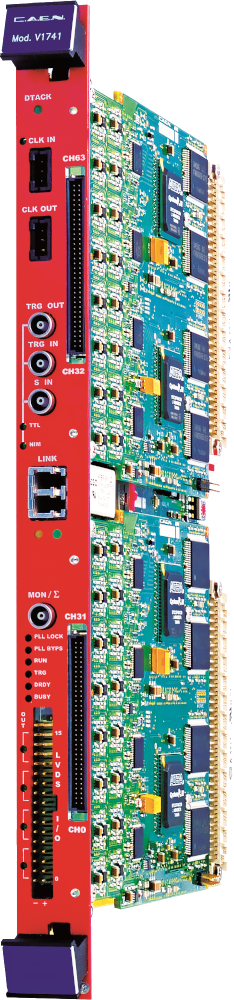
V1741
64 Ch Peak Sensing ADC
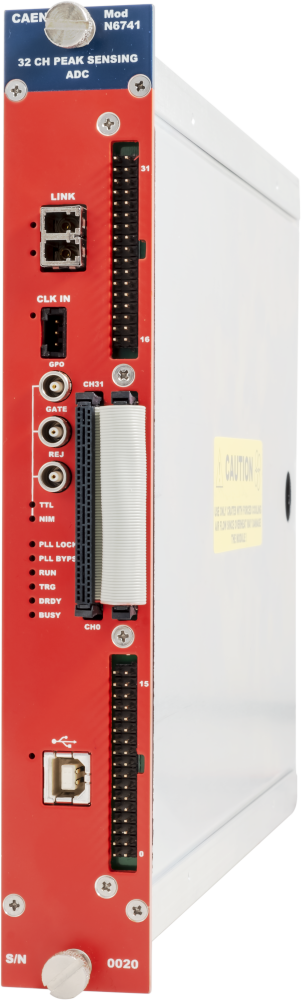
N6741
32 Ch Peak Sensing ADC
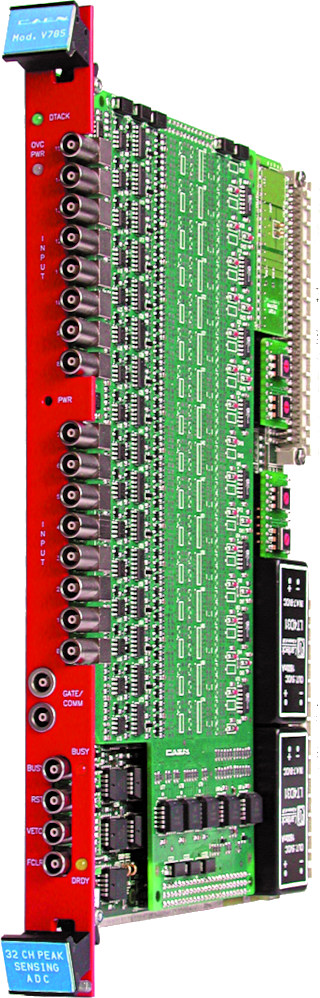
V785N
16 Channel Multievent Peak Sensing ADC
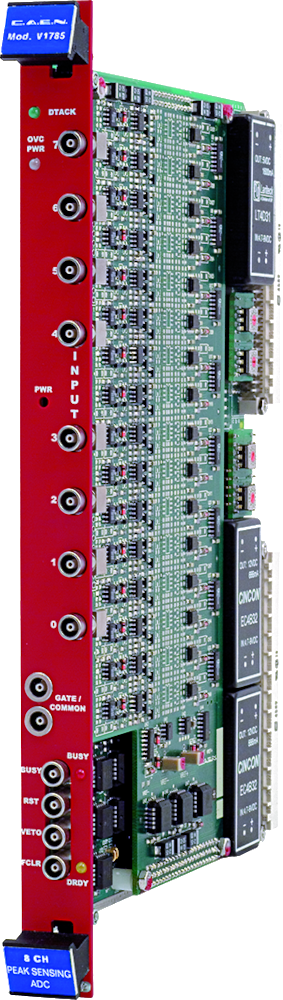
V1785
8 Ch Dual Range Multievent Peak Sensing ADC
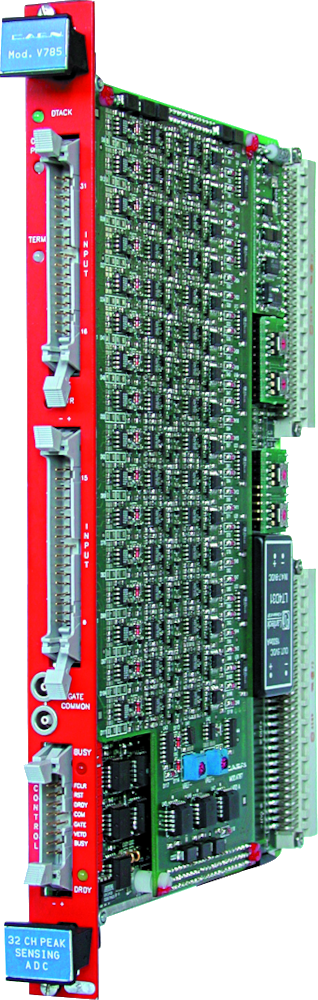
V785
32 Channel Multievent Peak Sensing ADC
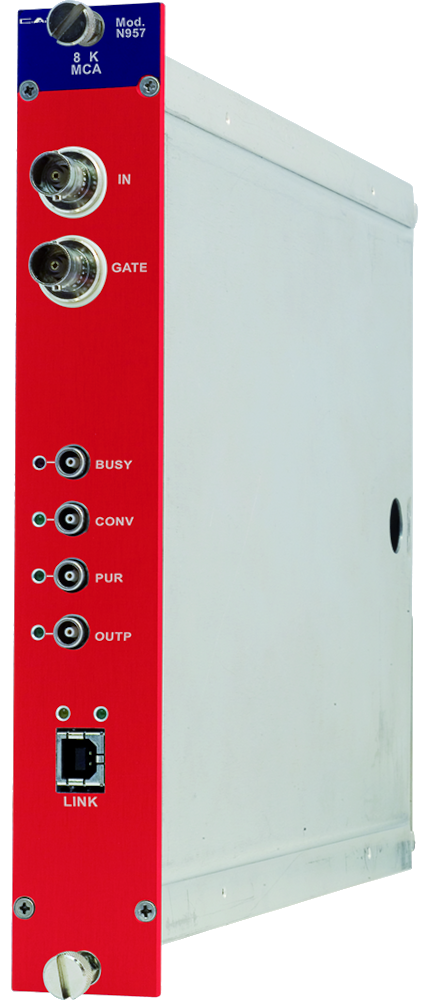
N957
8k Multi-Channel Analyzer
Image |
Name
|
Package | No. of Inputs | Resolution (channels) | Conversion Time (µs) | Full Scale Range (V) | Multi Event Buffer size | Connectors | |
 |
V1741 |
VME | 64 | 1k, 2k, 4k, 8k, 16k | 0.1 | 4 | 1024 events / ch | ERNI SMC | |
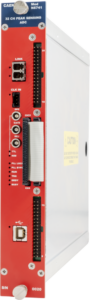 |
N6741 |
NIM | 32 | 1k, 2k, 4k, 8k, 16k | 0.1 | 4 | 1024 events / ch | ERNI SMC | |
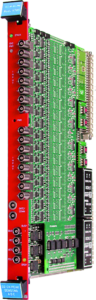 |
V785N |
VME | 16 | 4k | 2.8 | 4 | 32 events / ch | LEMO | |
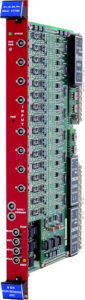 |
V1785 |
VME | 8 | 4k | 2.8 | 4 / 0.5 (Dual) | 32 events / ch | LEMO | |
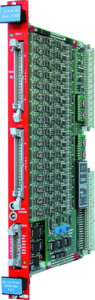 |
V785 |
VME | 32 | 4k | 5.7 | 4/8 | 32 events / ch | Std. Flat | |
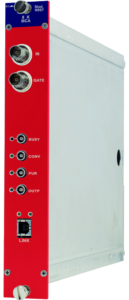 |
N957 |
NIM | 1 | 8k | 0.8 | 10 | 64k events / ch | LEMO |
Footer