

N1168
16 ch Fast Scintillator Programmable Signal Processor and 16 ch CFD
Highlights
-
16 channels in a one unit wide NIM module
-
Fast – Slow signal discrimination
-
Fast Scintillator application
-
Positive or negative inputs, hardware selectable
-
Completely programmable via USB, RS485 and Ethernet
-
3 Programmable shaping time per channel
-
2 bit Coarse Gain and 8 bit Fine Gain, independent for Slow and Fast/Aux output
-
Automatic DC Restorer for Fast/Aux and Slow output
-
ECL CFD output, with Delay and Width Individually programmable
-
CFD Crossing Delay hardware settable in 5 steps
-
CFD Threshold Individually programmable with 12 bit resolution
-
CFD walk automatically adjusted
-
OR output with individual channel enabling
-
Multiplicity output
-
Multiplexed Slow, Fast/Aux and CFD output
-
Multiplicity trigger output
-
Pile-up rejector
Overview
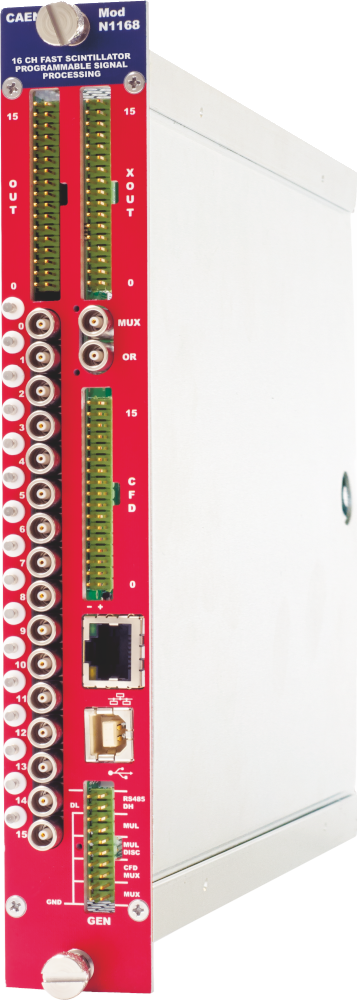
The CAEN Mod.N1168 is suitable for several type of scintillator detectors, particularly where different decay time of the scintillation light are present. This module allows to obtain the full handling of the detector signal, giving the total energy, amplitude of the fast component and the time information.
The analysis of the two dimensional spectrum (fast versus total) allows an excellent gamma-neutron separation for liquid scintillators or CLYC detectors, gamma-charged particle separation for BaF2 detectors, and to disentangle the gamma interaction in the different parts of a Phoswich detector.
For scintillator detectors with a single light component, the fast output can be used as a second total energy output, meeting the requirements of dual energy range experimental setups, avoiding the split of the signal on two shaping amplifiers.
The module is very simple to use and overcomes the inconveniences of the standard approach with two gates and QDC setup.
The board has two outputs for each input channel, where the first output is proportional to the integration charge (called SLOW output), and the second is proportional to the signal amplitude (called FAST output). The latter gives information of the shape of the input pulse, thus giving information to perform pulse shape discrimination with detectors that have a different response to particles, like gamma-neutrons.
For scintillator detectors with a single light component, the AUX output, that is a second slow output, can be used as a second total energy signal, meeting the requirements of dual energy range experimental setups, avoiding the split of the signal on two shaping amplifiers.
A gate-free fast stretcher circuit captures the leading-edge peak value of the signal, that is subsequently Gaussian shaped to allow simple acquisition by a peak-sensing ADC.
The total energy circuit basically consists of an integrator, followed by a Gaussian shaper amplifier. The time information is given by a Constant Fraction Discriminator, with selectable delay line and an automatically walk compensation circuit.
The very low noise level of the module matches the requirements of the new class of high energy resolution scintillators (LaBr3), over a large energy dynamics applications range, and also in a very low discrimination level.
A software tool that allows an easy management of all the functional parameters of the CAEN Spectroscopy Amplifiers is available too; supported operating systems are Windows and Linux.
(Designed in collaboration with INFN Milano).
You also may be interested in…
NIM8302
NIM8305
NIM8302P
NIM8303
NIM8306
NIM8304
N1068
N6741
Request a Quote

Compare

|
Image
|
Name
|
Package
|
No. of Channels
|
Gain
|
Coupling
|
Shaping
|
Input Impedance (Ω)
|
Output Rise Time (ns)
|
Output Range (V)
|
Integral Non- linearity
|
Equivalent Input Noise (µV RMS)
|
In Conn.
|
Out Conn.
|
|
|
N1168 |
NIM |
16 |
2 ÷ 512 |
DC |
Gaussian type |
50 |
- |
+8 on 1 MΩ |
< ±0.05% (Slow)<br> < ±0.5% (Fast) |
< 40 (Slow)<br> < 120 (Fast) (Gain=100x; 0.2 µs shaping time) |
LEMO |
Strip Header |
|
|
N1068 |
NIM |
16 |
2 ÷ 512 |
DC |
Gaussian type |
50 (SE) <br>110 (Diff.) |
- |
+8 on 1 MΩ |
< ±0.03% (S/D)<br> < ±0.03% (GE) |
< 15 (S/D)<br>< 11 (GE) (Gain=100x, 4 μs shaping time) |
LEMO /Strip Header |
Strip Header |
|
|
N968 |
NIM |
1 |
1 ÷ 3000 |
DC |
semi- Gaussian |
1000 |
- |
10 on 1 MΩ |
< ±0.025% |
< 3.5 (@gain=1000) |
BNC |
BNC |
Technical Specifications
|
Packaging |
One unit wide NIM unit |
|
Power requirements |
1.7 A @ +6V; 2.5 A @ -6V; 400 mA @ +12V; 220mA @ -12V |
|
Input |
Positive or negative pulses, max. amplitude of ±3V, 50 Ω impedance. Input polarity jumper selectable |
|
Slow OUT |
Unipolar gaussian; dynamic range 0 ÷ +8V max (on 1MΩ), 50 Ω back termination; offset adjust: -400 ÷ +400 mV; 8-bit resolution; common to all channels |
|
Fast/Aux OUT |
Unipolar gaussian; dynamic range 0 ÷ +8V max (on 1MΩ), 50 Ω back termination; offset adjust: -400 ÷ +400 mV; 8-bit resolution; common to all channels |
|
CFD OUT |
Diff. ECL output; width 50÷1150 ns, 5 bit adjustable |
|
MUX |
Output, on LEMO connector and on double row connector; options: Slow, Fast/Aux selectable, disabled; 0÷+8V max (on 1MΩ); 50Ω output impedance; high impedance when disabled. N.B. MUX out are attenuated by ~0.5 factor versus SLOW & FAST/AUX OUT; when used, they must be terminated on HIGH impedance |
|
OR |
Logical OR of the CFD Output, on LEMO connector, standard NIM output, width 145÷1250 ns, 5 bit adjustable. Individually Enabled |
|
MUX CFD |
CFD out of channel with MUX enabled. Std. NIM output on double row connector |
|
MUL |
Multiplicity out: analog sum of CFD OUT, -800µA output per hit; -40mV on 50 Ω |
|
MUL DISC |
Standard NIM output on double row connector; Multiplicity Trigger Discriminator (Time over threshold) with Programmable Threshold. |
|
Gain |
Product of coarse and fine gain setting. Coarse: 4-step adjustable (nominal: 1x, 4x, 16x, 64x); Fine: 0 ÷ 191 steps adjustable. Total range: 2.3÷312 for Negative inputs. With positive inputs, all values are halved |
|
Shaping time |
Slow Out-AUX: 0.2, 0.4, 0.8 μs; Fast Out: 0.2, 0.4 μs |
|
Integral non linearity |
t.b.d |
|
FAST-SLOW Crosstalk |
<-50 dB measured on FAST OUT, induced by SLOW OUT on same channel |
|
Slow equivalent Input Noise |
< 92 µV (Gain=100x; (0.2 µs shaping time) |
|
Fast equivalent Input Noise |
< 135 µV (Gain=100x; (0.2 µs shaping time) |
|
FAST-SLOW rejection |
< 30 dB |
|
CFD Threshold |
0 ÷ 4095 mV; 1mV step (12 bit resolution) |
|
CFD Zero Crossing Delay |
Selectable by jumper (5 steps): 1.5ns, 3ns, 4.5ns, 6ns, 7.5ns |
|
Delay on CFD ECL Output |
Range: (20ns – 1100 ns) 5-bit resolution, individually programmable and disable |
|
Pile-up rejection |
Individually selectable; when a pile-up event occurs within 3T output saturation is forced |
|
CFD Threshold |
0 ÷ 4095 mV (12 bit resolution) |
|
CFD Zero Crossing Delay |
Selectable by jumper (5 steps): 1.5ns, 3ns, 4.5ns, 6ns, 7.5ns |
|
Delay on CFD ECL Output |
Range: (20ns – 1100 ns) 5 bit resolution, individually programmable and disabled |
|
Interfaces |
|
Footer