


Highlights
-
Lab experiments without radioactive sources or detectors
-
Realistic emulation of energy spectra, noise and continuous preamplifier signals
-
γ and α spectroscopy and system linearity studies
-
User-programmable FPGA for pulse processing, complex trigger logic, event counters and statistics
-
Ready-to-use virtual instruments: SCA and MCA, TDC, waveform digitizer, logic analyzer
-
Time tagging and real-time Time-of-Arrival distribution
-
X-ray and gamma-ray imaging
-
Drop-in replacement for legacy logic-based systems
Overview
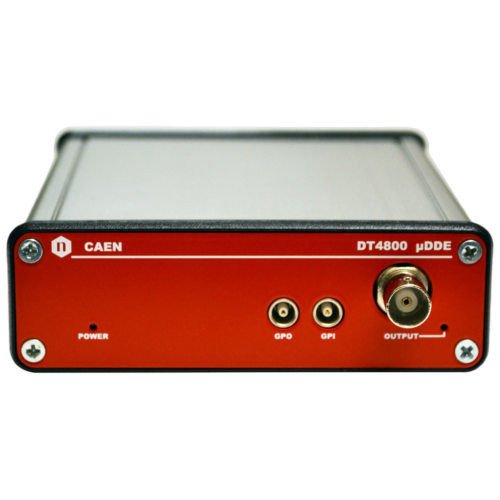
The SP5650 Open FPGA Kit brings together two CAEN instruments in a single, compact lab setup: the DT4800 Micro Digital Detector Emulator and the DT1260 Open FPGA digitizer. Together, they let students and researchers run a full series of experiments without a radioactive source or a physical detector, while learning to design their own signal processing in firmware.
On the generation side, the DT4800 reproduces the signals produced by particles interacting with a detector. The most compact and cost-effective model of the CAEN Detector Emulator family, it is designed for single-channel emulation and educational use, and features one analog output, one digital input and one digital output. Used as a pulser, it generates exponential decay signals with programmable rise and fall times at rates up to 1 Mcps, with a fixed rate or one following a Poisson distribution.
These signals are then acquired by the DT1260, a dual-channel digitizer built for users approaching Open FPGA programming for the first time. Inputs are fed through LEMO connectors and sampled by a 12-bit, 65 MS/s ADC. The real strength of the board lies in its freely reprogrammable FPGA: users design the firmware themselves in SCI-Compiler, combining prebuilt functions such as oscilloscope, TDC and MCA to implement the processing best suited to each application.
Experiments
The SP5650 is supported by a progressive series of guided experiments on the CAEN Educational website. Built in SCI-Compiler, they take students from their first FPGA design to complete pulse processing chains. Each guide explains the concepts, the design and the expected results, and can be downloaded as a printable version.
Getting started
Counting and timing
-
SG6310F – Timestamp and Time-over-Threshold with List Data Buffer
-
SG6311F – Python Readout, Decoding, and Plotting of ToF and ToT
Pulse processing
-
SG6312F – Leading Edge with Hysteresis, Derivative, and Trapezoidal Trigger Comparison
-
SG6315F – Trapezoidal Filtering with a Fully Integrated MCA IP Core
-
SG6317F – Implementing a Pulse Shape Discriminator (PSD) Based on Amplitude vs. Area Ratio
-
SG6318F – Implementing a Pulse Shape Discriminator (PSD) Based on Ratio Between Areas
Multichannel and modular design
Browse all Digital Pulse Processing (Open FPGA) experiments on edu.caen.it.
You also may be interested in…

Request a Quote

Footer