

Highlights
-
2 channels
-
2 units, NIM standard
-
Either backplane or AC-DC power supply
-
Pulser/Emulator/Function Generator operating modes
-
Energy spectrum emulation
-
Time distribution emulation
-
Custom signal shape emulation
-
Pile-up emulation
-
Noise and periodic interference emulation
-
Baseline drift
-
12 ps/step programmable delay generator
-
Correlated signals generation on the two output channels
-
Multiple shape on the same channel for testing of pulse shape discrimination
-
Continuous and pulsed reset pre-amplifier emulation
-
Nuclide Database
-
USB 2.0 interface
-
Windows Software
Overview
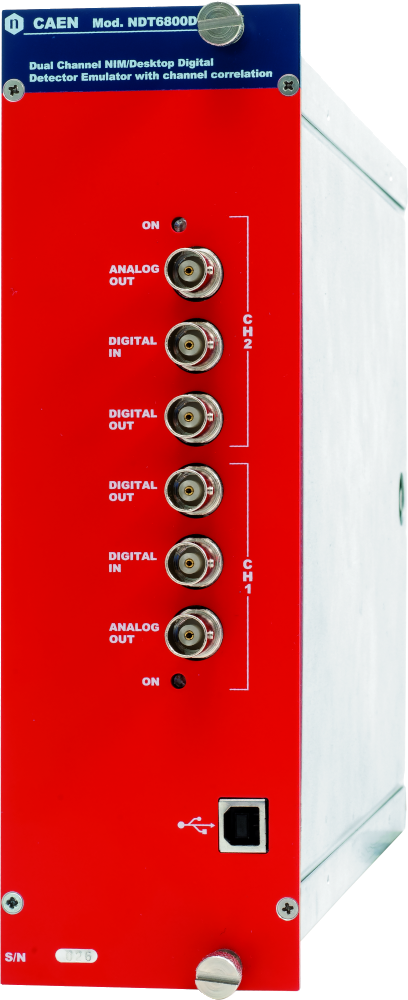
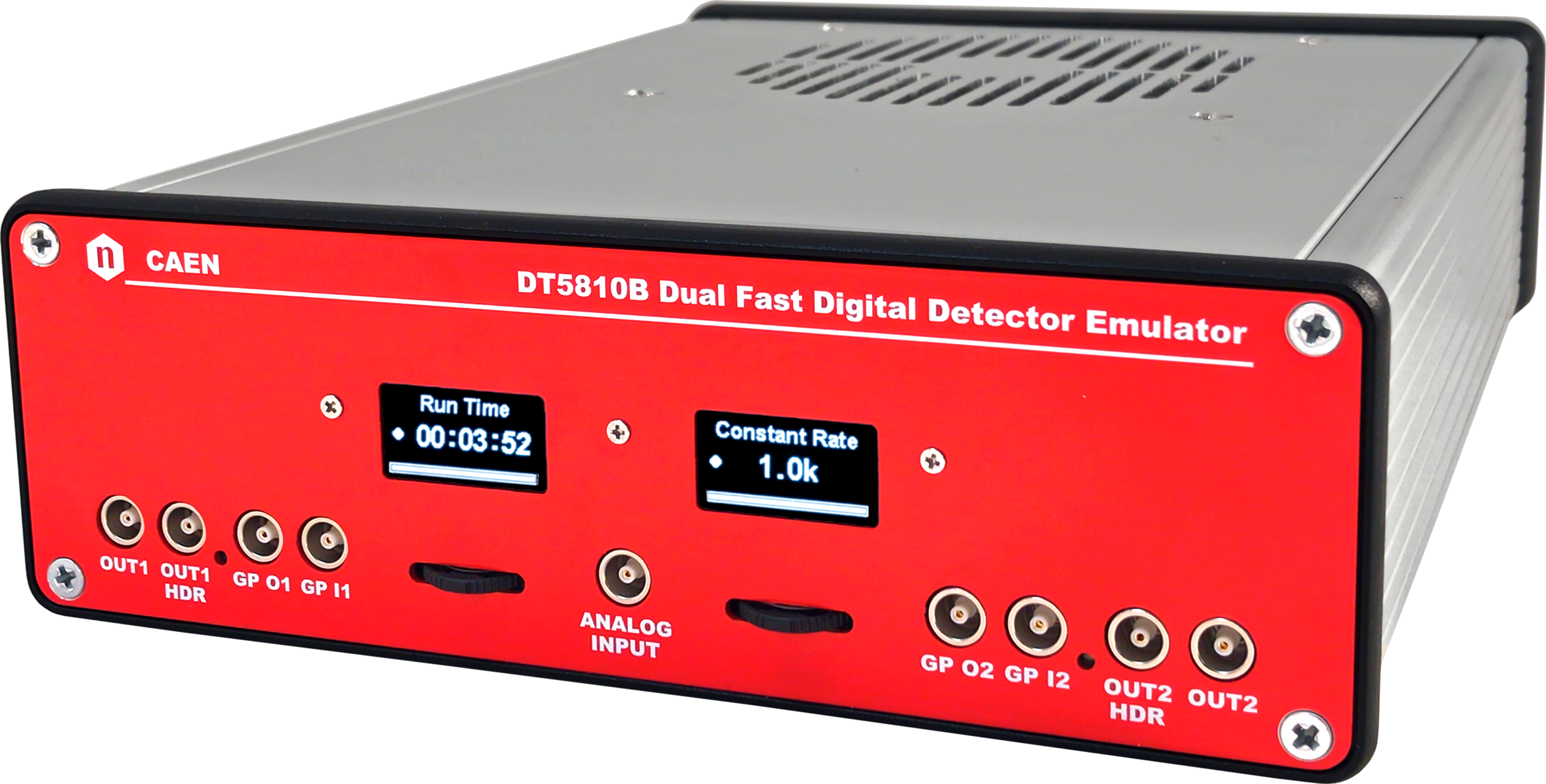
The CAEN Mod.NDT6800 is a Dual Channel Detector Emulator, an instrument for emulating in real time signals from generic setups for radiation detection, which can be operated as Desktop units. It shares the same functionalities as the DT5800 and can operate in three modes: Pulser Mode, Emulation Mode and Waveform Generator Mode.
The output generated by the device can go up to 2 V (4 V in case of high Z) and the maximum pulse rate is 10 Mcps (5 Mcps in Poisson statistics mode). In the detector emulator operating mode, the system is able to emulate with high accuracy a radiation detection system from the detector output to its related front-end electronics. The user can program different emulation parameters like signal shape distributions, energy spectra, time distribution, as well as noise characterization and baseline drift.
Thanks to the 12 ps/step delay generator they are particularly suited for timing application. Moreover, the multiple shapes capability can be used for pulse shape discrimination applications. The two channels can be correlated either with the same or different statistical distributions.
Operating modes:
-
PULSER
Classic pulser operation. The system allows to set the signal amplitude, the signal rate, and to choose between constant and Poisson distributed rate.
-
DETECTOR EMULATOR
In the detector emulator operating mode, the system is able to emulate with high accuracy a radiation detection system from the detector output to its related front-end electronics. The user must provide: the signal shape distribution, the required energy spectrum, the time distribution, the noise characterization, and the baseline drift.
The signal shape can be generated either by using the system internal database, or using recorded shapes from the experimental setup. The same is true for the energy spectrum. It is possible to create several emission lines through the tool itself, or to import a file in the format of CVS/ANSI N42.42, or to use the internal database electronics. The user can choose a Poisson or any arbitrary time distributions. It is also possible to emulate white noise, 1/f noise, random walk, as well as interferences. The characterization of the baseline drift can be also added.
-
CORRELATED EVENT GENERATOR
The instrument allows to generate correlated events with fixed time shift (time steps of 12 ps). The two signals can have either the same or different statistical distributions. Furthermore, it is possible to generate a subset of events according to a fixed energy spectrum, being statistical uncorrelated from the background events.
-
ARBITRARY WAVEFORM GENERATOR
The instrument comes with 1M points of RAM memory per channel to store and then reproduce the events from pre-defined functions.
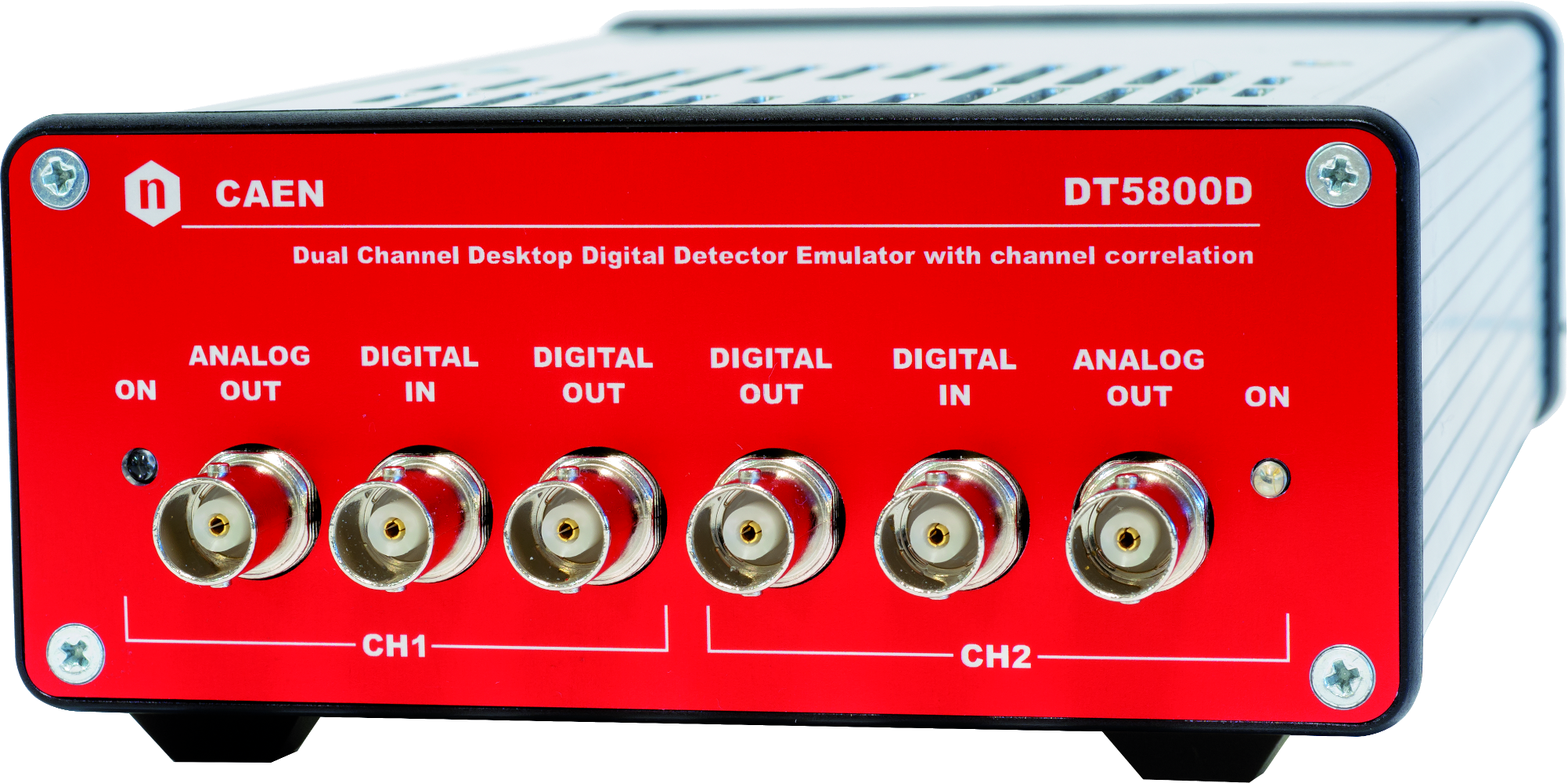
The Desktop Digital Detector Emulator is available in single (NDT6800S) or dual channel (NDT6800D) version. The dual channel model allows the event correlation.
USB 2.0 communication interface, Front panel USB connector.
Either NIM backplane or AC-DC power supply. The latter allows to use the crate stand-alone, without the NIM crate.
Active cooling system for non-cooled NIM crates.
The delay line for the time correlation is thermalized through a Peltier cell to minimize the thermal drift (temperature stability of about 0.03°C).
Software tool compliant with Windows OS. Shape and spectrum files import from any Digital Pulse Processors, Digitizers, and oscilloscopes. Model shape generation (with no noise) from input waveforms.
Programmable digital outputs: Trigger in, Trigger out, and Gate.
Request a Quote

Compare

|
Image
|
Name
|
Channels
|
D/A Sample rate
|
Maximum Rate
|
Multiple shapes on a single channel
|
Minimum rising time (fast mode)
|
Form Factor
|
|
|
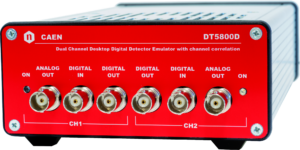
DT5800 |
2 |
125 MHz |
0 Mcps / 5 Mcps (Poisson) |
Yes (2 different) |
8 ns |
Desktop |
|
|
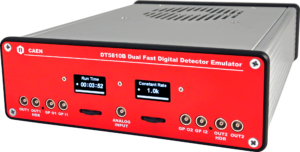
DT5810 |
2 |
1 GHz |
30 Mcps |
Yes (4 different) |
1 ns |
Desktop |
|
|
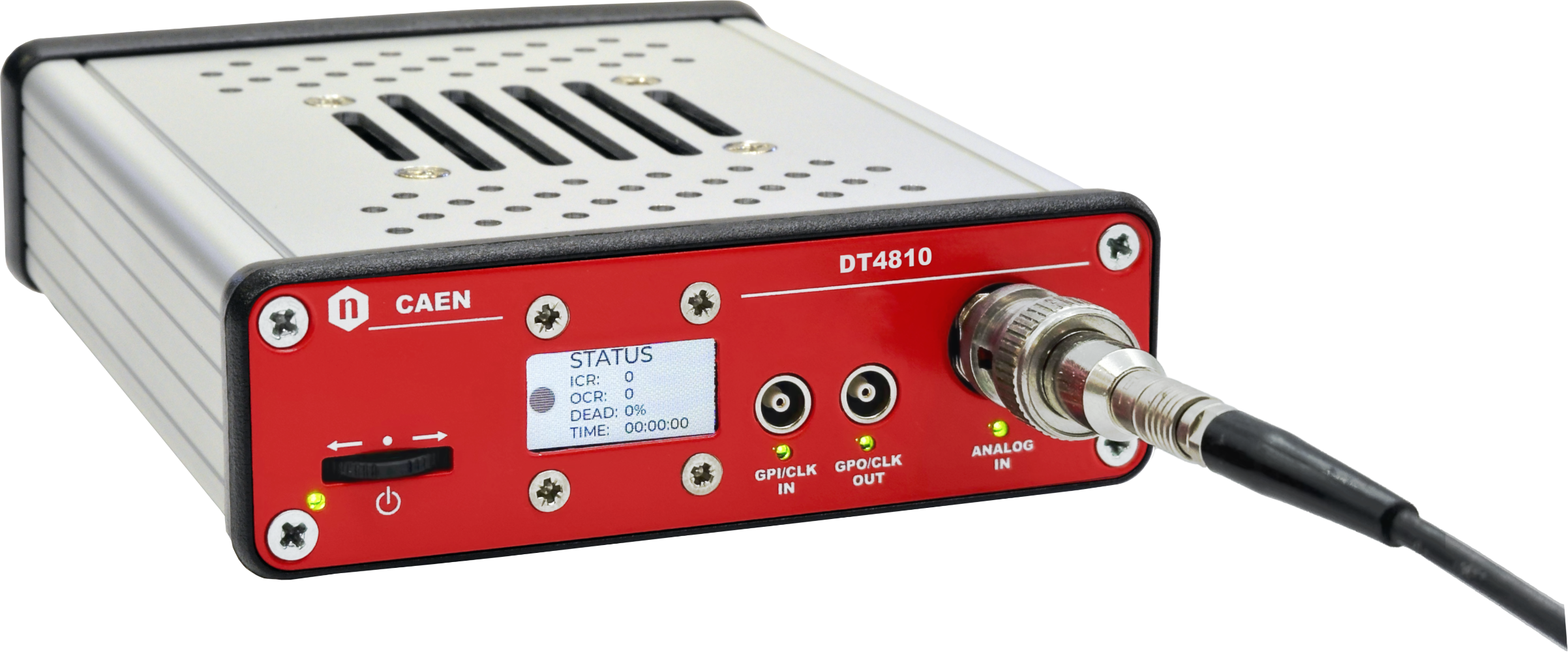
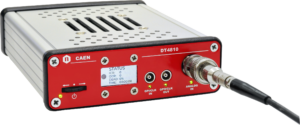
New DT4810 |
1 |
500 MHz |
Tbd |
No |
5 ns |
Desktop |
|
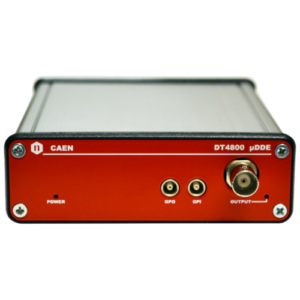
|
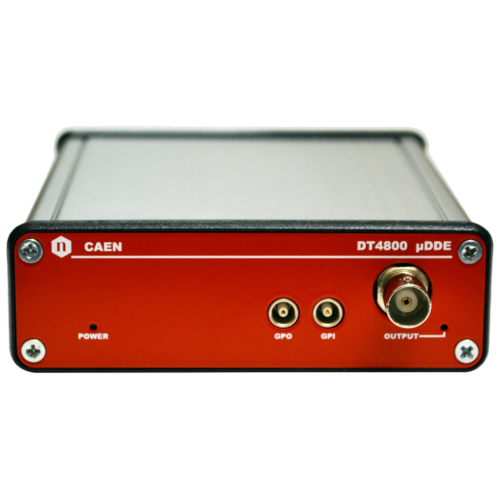
Discontinued DT4800 |
1 |
200 MHz |
Tbd |
No |
7 ns |
Desktop |
Technical Specifications
|
Energy emulation features |
|
|
Time emulation features |
|
|
Signal shape |
|
|
Noise emulation |
|
|
Baseline |
|
|
Correlated events emulation |
|
|
Digital I/O |
|
|
RNG (random number generator) |
|
|
Programmable sequence |
|
|
Arbitrary waveform generator |
|
|
Software and interfaces |
|
Footer