
• Skip to main content
  • Skip to footer
CAEN logo light
  • About
    • Company Profile
    • Our policy
    • Sales network
    • Innovative Projects
    • Careers
    • How to reach us
  • Products
  • Resources
    • Documentation
    • Download
    • FAQ
    • Glossary
    • Certifications
    • General Conditions
  • Support
  • Contact
All productsForm FactorPower SupplyModular Pulse ProcessingDigitizer FamiliesDigital SpectroscopyCAEN SyS productsEducationalFirmware & SoftwarePowered CratesAccessoriesBrands
New

DT2751

16 Input Channel 14 bit 1 GS/s Digitizer with Programmable Input Gain
Datasheet

Home Digitizer FamiliesDigitizers 2.0 - Open FPGA14-bit 1 GS/s DT2751

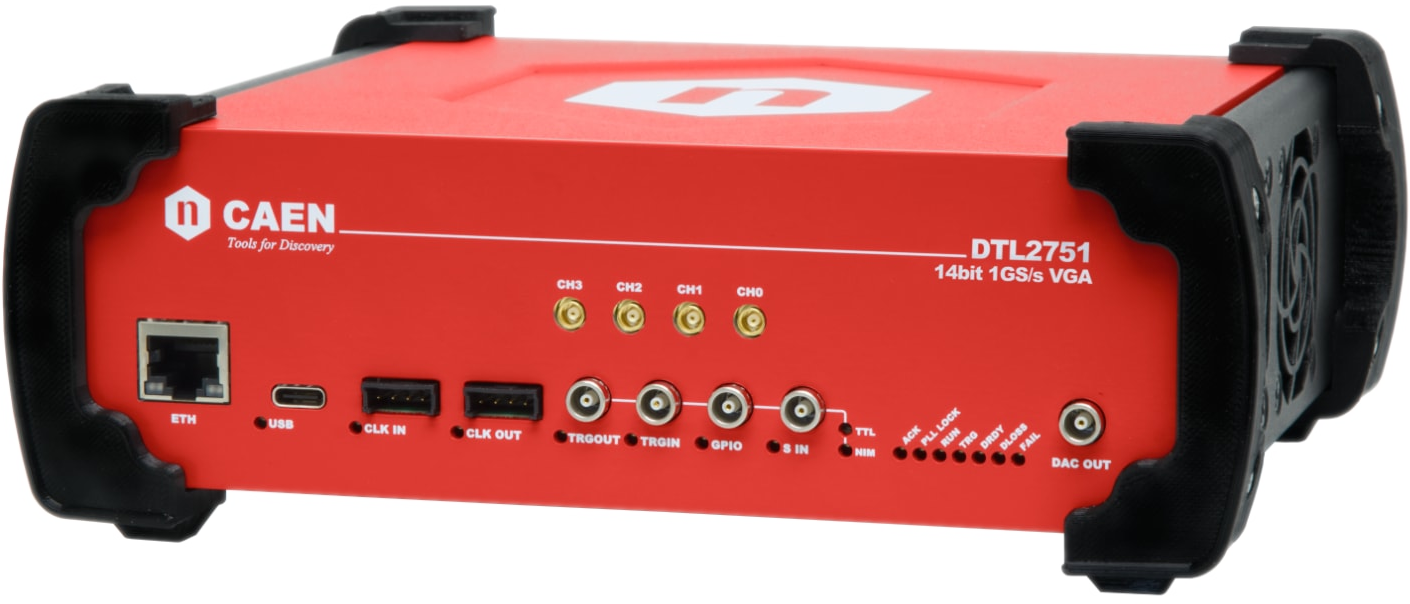
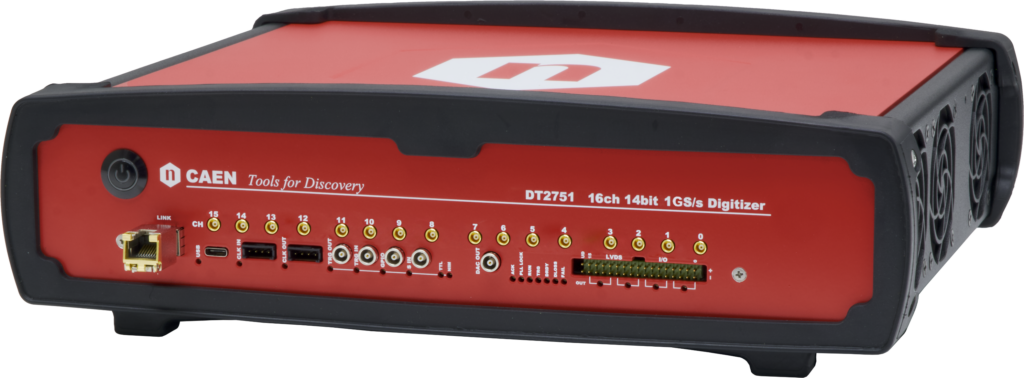
Photo of DT2751
  • 16 independent input channels, 1 GS/s 14-bit, with individual DC offset adjustment and Software selectable analog gain (VGA)

  • Front panel readout via USB-3.0 or 1/10Gb Ethernet

  • On-board Zynq® UltraScale+™ FPGA with embedded Linux-based ARM® processor

  • 5GB of total acquisition memory (DDR4)

  • Open FPGA architecture fully supported by SCI-Compiler tool

  • Ready-to-Use Firmware solutions to get time-stamped waveforms and physical quantities (check here for the available options)

  • Triggered and Streaming Readout modes supported

  • System features: Multi-board synchronization, digital I/Os for trigger logic, on-board storage of multiple firmware images, 125MS/s 14-bit DAC output and integrated web interface

  • Software ecosystem:

    • GUI-based readout software available for multiparametric spectroscopy (CoMPASS) or waveform recording (WaveDump2)

    • Firmware/software generator and compiler for the Open FPGA (Sci-Compiler), eliminating the need for FPGA programming skills

    • Libraries (FELib) and demo codes are provided for software customization

  • Wide range of applications (from Nuclear and Particle Physics to High Timing Resolution, Fast Neutron Spectroscopy, Dark Matter and Astroparticle, Fusion Plasma diagnostic, and Homeland Security)

  • Suited for signals from fast organic, inorganic and liquid scintillators coupled to PMTs or SiPMs, Diamond detectors and others

The DT2751 Digitizer is a 16 input channel digital signal processor for radiation detectors in the Desktop form factor. It offers not only waveform digitization and recording but also Multi-Channel Analysis for a complete range of applications of nuclear and particle physics, high-timing resolution, Fast Neutron Spectroscopy, Dark Matter and Astroparticle, Fusion Plasma diagnostic, and Homeland Security. It is compliant with fast signals typically coming from organic, inorganic, and liquid scintillators coupled to PMTs or SiPMs, as well as Diamond detectors.

The DT2751 can perform different types of signal processing, basing on algorithms like charge integration and pulse shape discrimination (PSD), constant fraction timing (CFD), and zero-length encoding (ZLE). The algorithm parameters can be set individually for each channel or globally for all channels on the board.

Each input channel is able to independently digitizing detector signals through a 14-bit ADC at 1 GS/s. Data acquisition is driven by trigger signal generation and the identification of a Region of Interest (ROI), defined in terms of sample count or time duration. Trigger sources can be local (channel self-trigger), external, or software-based. Once acquired, the digitized data is processed within the FPGA, stored in high-speed memory as events—including Trigger ID and Timestamp tags—and then transferred via high-bandwidth communication interfaces for further analysis.

The digitizer supports different acquisition modes, designed to balance throughput, latency, and data efficiency according to experimental requirements:

  • Triggered Mode: All channels acquire data simultaneously upon a global trigger generated by a Central Logic Unit, which processes local triggers from individual channels. External and software triggers can also be configured as sources for the global trigger. Zero suppression algorithms can be applied to remove non-significant data and reduce the readout payload.

  • Streaming Readout Mode: Each channel autonomously identifies its ROI using the self-trigger mechanism, acquiring data independently of the other channels. This mode includes automatic zero suppression (non-triggered channels are not acquired), maximizes acquisition rates, and is ideal for applications requiring real-time parameter extraction. In addition, correlation logics can be configured to validate event acquisition upon coincidences or anticoincidences between local and external triggers.

The DT2751 can operate using both pre-configured firmware developed by CAEN and custom user-generated firmware, offering flexibility for a wide range of applications. Multiple firmware images can be stored simultaneously in the digitizer’s FLASH memory and quickly activated when needed. CAEN provides ready-to-use firmware solutions optimized for specific acquisition and processing needs:

  • Scope Firmware: Based on full waveform recording in triggered acquisition mode. A zero suppression function is available to reduce unnecessary data readout.

  • DPP-PSD Firmware: Implements Digital Pulse Processing algorithms for charge integration and pulse shape discrimination. Physical parameters such as energy, timestamp, and PSD are extracted from waveforms acquired in streaming readout mode. A CFD (Constant Fraction Discriminator) function is available for precise timestamping.

For users requiring custom acquisition and processing, the Open FPGA architecture enables firmware customization through SCI-Compiler. This graphical tool allows users to create personalized firmware solutions without HDL skills. In addition, Sci-Compiler automatically generates drivers and libraries and provides graphical utilities for developing custom DAQ software.

The Linux-based Arm processor embedded in the onboard CPU makes it possible to run automated user routines. Multi-board synchronization can be implemented via backplane or front panel easy-cabling options. Multiple communication interfaces offer flexible readout options: USB 3.0 type-C and 1/10 Gigabit Ethernet.

For detailed information on available firmware for the 2751 family and the structure of programming files (.CUP), please refer to the following page.

This product is compatible with the following third-party software:

  • PKUCAENDAQ

Software

CAEN Toolbox

Multi-Functional Software Suite for the Upgrade of Front-end Boards, Bridges and Power Supplies

COMPASS

Multiparametric DAQ Software for Physics Applications

Sci-Compiler

Graphical Programming Language for CAEN Open FPGA Boards

CAEN FELib Library

High level library for CAEN Digitizers 2.0

WAVEDUMP2

Open Source Software for Digitizer 2.0 and 1.0 Series

Firmware

D-SCOPE

Digitizer 2.0 Waveform Recording Firmware

DPP-PSD

Digital Pulse Processing for Charge Integration and Pulse Shape Discrimination

DPP-SUP

Super Licence for CAEN Digitizers

Ordering Options

Code Description
WDT2751XAAAA

DT2751 – 16ch 14bit 1GS/s 2Vpp SE VGA Digitizer

RoHS

You also may be interested in…

DTL2751

DTL2751

4 Input Channel 14 bit 1 GS/s Digitizer
VX2751

VX2751

16 Input Channel 14 bit 1 GS/s Digitizer with Programmable Input Gain
Download Compare Tech. Spec.

Add to Wishlist
This product is already in your Wishlist
Browse the Wishlist

Request a Quote

Request a Quote

    Submit I’ve read and accept the privacy policy *

    Compare

    Close
    Image
    Name
    Package
    No. of Channels
    Max Sampling Rate (MS/s)
    Bandwidth (MHz)
    Full Scale Range (V)
    Resolution (bits)
    Board Memory (Samples/ch)
    Analog Input Connectors
    CAEN firmware
    Open FPGA
    DT2751
    New

    DT2751

    Desktop

    16

    1000

    500

    [0.2 ÷ 2]

    14

    84 M

    MCX

    DPP-PHA, DPP-PSD, D-SCOPE<sup>(cs)</sup>

    YES

    VX2751
    New

    VX2751

    VME64X

    16

    1000

    500

    [0.2 ÷ 2]

    14

    84 M

    MCX

    DPP-PHA, DPP-PSD, D-SCOPE<sup>(cs)</sup>

    YES

    DTL2751
    New

    DTL2751

    Desktop

    4

    1000

    TBD

    TBD

    14

    MCX

    TBD

    DPP-PSD(cs), D-SCOPE(cs)

    YES

    Technical Specifications

    Close

    GENERAL

    Weight: 3120 g (Desktop); 32170 g (Desktop Rack)

    Form Factor: Desktop | Desktop Rack

    Dimension: 338 W x 100 H x 283 L mm³ (Desktop without connectors) | 338 W x 100 H x 295 L mm³ (Desktop including connectors) | 19” rack mount (Desktop Rack)

    ANALOG INPUT

    • Number of Inputs: 16, single-ended, DC coupled

    • Bandwidth (-3dB): 450 MHz guaranteed for all Gain settings

    • Impedance: 50 Ω

    • Gain: x1 ÷ x10, software programmable in steps of 1dB independently on each input channel

    • Connector Type: MCX

    • Full Scale Range: 2 Vpp ÷ 0.2 Vpp

    • DC Offset: Adjustable in the ±1V range independently on each input channel

    DIGITAL CONVERSION

    • Resolution: 14 bits

    • Sampling Rate: 1 GS/s (simultaneously on each input channel)

    SYSTEM PERFORMANCE

    • ENOB (Typ.): 10.0 (@50MHz, -3dB, Gain x1)

    • RMS (Typ.): 3.2 LSB RMS (@Gain x1)

    DIGITAL I/O

    LVDS I/O

    TRG-IN/TRG-OUT/GPIO/S-IN

    • 16 differential pairs

    • Sw programmable I/O function (individual self-trigger outputs, trigger validations, Veto, Busy, Start, Stop, Pattern Input, etc.)

    • LVDS

    • Zdiff = 100 Ω (when set as inputs)

    • 2.54mm 34-pin AMPMODU Mod II male connector

    • General-purpose digital I/Os

    • Sigle-ended TTL/NIM

    • LEMO 00 male connector

    • Software programmable function (trigger, veto, busy, etc.)

    • TRG-IN/S-IN: internally terminated with 50 Ω (Zin = 50 Ω)

    • TRG-OUT requires Rt = 50 Ω

    • GPIO as Input must be terminated with 50 Ω

    • GPIO as TTL Output requires Rt = 50 Ω

    • GPIO as NIM Output requires Rt = 50 Ω or 25 Ω

    ANALOG OUTPUT

    • Sw programmable DAC output for signal inspection, pulse generation, majority level

    • 14-bit Digital-to-Analog Converter (DAC)

    • 125 MS/s Update Rate

    • LEMO 00 connector

    • ±1 V @ 50Ω load

    • ±2 V @ hi-Z load Output Range

    ACQUISITION MEMORY

    • 5 GB total DDR4 memory size (83.886 MS/ch) divisible in multiple buffers

    • Maximum record length: ~84 ms @ 1 GS/s (total memory size divided by 2)1

    (1) Value referred to the Scope firmware (minimum of two buffers admitted)

    COMMUNICATION INTERFACES

    1 GbE

    10 GbE (Contact CAEN Support)

    USB 3.0

    • Copper RJ45 or optical LC connector on SFP+ transceiver

    • Protocol: TCP

    • Transfer rate: 110 MB/s

    • Copper RJ45 or LC optical connector on SFP+ transceiver

    • Protocol: UDP

    • Transfer rate: 850 MB/s

    • Connector Type: USB-C

    • Protocol: USB 3.1 GEN1

    • Transfer rate: 280 MB/s

    TRIGGER AND EVENT ACQUISITION

    Triggered Mode

    Trigger Sources

    Trigger Timestamp – Scope firmware

    All the channels fire simultaneously upon a global trigger generated by the Central Logic Unit receiving the trigger source signals; a zero suppression function is available.

    • Software by register writing

    • External upon the leading edge of The TRG-IN signal (TTL/NIM)

    • Local (self-trigger) upon the channel discriminator with programmable threshold

    • Resolution: 8 ns coarse time stamp

    • Counter range: 48 bits

    • Full-scale range: ~625 h

    Streaming Readout Mode

    Each channel autonomously identifies the ROI and uses the local trigger to get events independently on the other channels; validation logics can be configured for correlated acquisition (coincidence/anticoincidence).

    Trigger Timestamp – DPP firmware

    • Resolution: 1 ns coarse timestamp, 1 ps fine timestamp

    • Counter range: 48 bits

    • Full-scale range: ~78 h

    SYNCHRONIZATION

    Clock Generation

    CLK-IN/CLK-OUT Connector

    By default, the Digitizer’s main clocks can be optionally generated upon from the internal 50MHz or external 62.5MHz reference (CLK-IN). Onboard programmable PLL allows locking to different external frequencies.

    • Two differential pairs:

      – CLK, reference clock signal

      – SYNC, synchronization signal (start/stop, T0, etc.)

    • 2.54mm 4-pin AMPMODU Mod II male connector

    • CLK-IN: AC-coupled LVDS, ECL, PECL, LVPECL, CML (Zdiff = 100 Ω)

    • CLK-OUT: LVDS

    Clock Synchronization

    Default 62.5MHz frequency distributed by:

    • Fan-out to CLK-IN

    • CLK-IN/CLK-OUT Daisy chain with sw programmable CLK-OUT delay shift

    Custom frequencies can be supported upon request.

    Data Synchronization

    Programmable Busy/Veto logic on differential LVDS I/O, or single-ended NIM/TTL I/O for event building.

    Run Synchronization (Acquisition Start/Stop)

    Optionally, by Daisy chain or fan-out propagation through differential CLK-IN/CLK-OUT or LVDS I/O, or single-ended NIM/TTL I/O.

    Trigger Distribution

    TRG-IN/TRG-OUT NIM/TTL LEMO I/O (global trigger) or LVDS I/O (global or local trigger).

    Trigger Time Stamp Reset

    Optionally, by Software from start run command or Hardware from S-IN/GPIO input (Scope Firmware only).

    FPGA

    • Xilinx Zynq UltraScale+ Multiprocessor System-on-Chip mod. XCZU19EG

    • Processing System based on Quad-core Arm with 2GB DDR4 memory @2400 MT/s (Linux OS onboard)

    • Programmable logic with more than 1100K system logic cells and 80 Mbit memory

    CAEN FIRMWARE

    Developed by CAEN, stored in the on-board FLASH memory, and live rebootable by Web Interface.

    DPP Firmware (Shareware)

    Scope Firmware (Freeware)

    Upgrades  (Free)

    Pay firmware implementing a digital pulse processing algorithm:

    • DPP-PSD: Charge Integration, Pulse Shape Discrimination, CFD for fine timestamp

    30-minute per power cycle in Trial mode; license is required for full-time work.

    Designed for waveform recording.

    Web available CUP files for Scope and DPP firmware upgrade via Web Interface or CAEN Toolbox software.

    USER FIRMWARE (OPEN FPGA)

    Sci-Compiler (Shareware)

    Pay graphical tool for User Firmware generation and compiling with CAEN Programmable Boards.

    Scope Personalization

    DPP Personalization

    Customizable features of the Scope firmware:

    • Common trigger

    • Simultaneous waveform recording management on all the input channels

    • Trigger logic

    • Wave processing

    Customizable features of the DPP firmware:

    • Individual trigger and channel acquisition management

    • DPP algorithm

    • Trigger logic

    • Event data information

    SOFTWARE

    Readout SW for CAEN Firmware (Freeware)

    SCI-Compiler for Open FPGA (Shareware)

    • CoMPASS spectroscopy software (DPP firmware only)

    • WaveDump2 (Scope firmware only)

    Automatic generation of drivers (USB, Ethernet), libraries, and demo software for Windows®, Linux®.

    SDK and Tools (Freeware)

    General-purpose libraries (C/Python) with demo samples for host Windows® and Linux® PC, and embedded Arm.

    Web Interface

    Firmware management (e,g. upgrades and on-the-fly selection of the firmware to run), board information, PLL and Ethernet configuration, board status monitoring.

    ENVIRONMENTAL

    • Environment: Indoor use

    • Operating Temperature: 0°C to +40°C

    • Storage Temperature: -10°C to +60 °C

    • Operating Humidity: 10% to 90% RH non condensing

    • Storage Humidity: 5% to 90% RH non condensing

    • Pollution Degree: 2

    • Overvoltage Category: II

    • EMC Environment: Commercial and light industrial

    • IP Degree: Enclosure (desktop models), not for wet location


    REGULATORY COMPLIANCE

    • EMC: CE 2014/30/EU Electromagnetic Compatibility

    • Directive Safety: CE 2014/35/EU Low Voltage Directive

    POWER REQUIREMENTS

    Mains-powered (AC input = 100-240V~, 50/60Hz; Max. power = 130W).

    Footer

    CAEN S.p.A.

    PI 00864500467 | REA: LU 102690

    C.I.V.: 500.500€ | CDU A47Ø7H7

    IMQ Certification
    Cyber Essentials Plus

    About Us

    • Company Profile
    • Our policy
    • Sales network
    • Innovative Projects
    • Careers
    • How to reach us

    Resources

    • Documentation
    • Accessibility Statement

    Applications

    • High Energy Physics
    • Astrophysics
    • Neutrino Physics
    • Dark Matter Investigation
    • Nuclear Physics
    • Material Science
    • Medical Applications
    • Homeland Security

    Support

    • Getting Started with MyCAEN Portal
    • CAEN LHC Commitment

    News

    • News

    Contact Us

    • Contact

    Login

        
    • Privacy Policy
    • Cookie Policy

    Copyright © 2026 CAEN S.p.A. All rights reserved. Website by Addiction

    ✕